Championing Child Health: Driving Policy and Advocacy Forward
Children’s Healthcare Canada (CHC) remains steadfast in our commitment to improving experiences and outcomes of healthcare for children and youth across the country. Below are the issues and areas of focus that CHC, our partners, and members are working to advance:
In this issue:
- Establishing the measurable return on investments in children’s healthcare
- Establishing rapport with senior officials in Health Canada
- Creating alignment across federal, provincial and territorial governments
- Championing Bill S-212 – An Act respecting a national strategy for children and youth in Canada
- Building Visibility
- Positioning Children’s Healthcare Infrastructure as a priority for the eligibility of the Building Canada Strong Fund
- Online Harms
- Interim Federal Health Program
- List of Therapeutic Products Pre-approved for Special Access
1. Establishing the measurable return on investments in children’s healthcare
In the fall of 2025 Children’s Healthcare Canada, in partnership with Canada’s Children’s Hospital Foundations, released Thrive: The Economic Case for Investing in Children’s Health, the first national analysis of the return on investment in children’s healthcare in Canada. Conducted by Deloitte, the report demonstrates that every dollar invested in children’s healthcare, generates up to a five-fold return in societal and economic gains.
On November 17, Minister of Health Marjorie Michel joined CHC for a luncheon hosted by the Canadian Club of Ottawa, publicly launching Thrive at the National Arts Centre in Ottawa. Watch the Minister’s remarks here.

2. Establishing rapport with senior officials in Health Canada
Former Health Canada Deputy Minister Orencsak joined CHC’s Executive Network in early December 2025 to share several priorities for the current Minister of Health, such as:
- Working collaboratively with provinces to help recruit and retain international medical graduates in Canada. They pointed to increased funding to help newcomers navigate the credential recognition systems.
- Increasing awareness of mental health challenges and boosting funding for programs such as the Integrated Youth Centers. The Minister had a particular focus on men’s and boys’ mental health, which was confirmed by the recent launch of the National Men and Boy’s Health Strategy.
- Collaborating with the provinces and territories to create common health indicators and standards to facilitate data sharing. Health Canada is also working with CIHI to develop common indicators on shared priorities. This has been confirmed by the recently introduced Connected Care legislation, which aims to make it easier to share healthcare information, medical records and personal health data by requiring health tech companies to adopt common standards to make it easier to securely transfer this information.
- On the regulatory front, Health Canada has launched two consultations to guide amendments to regulations on the issues of clinical trials and drug approvals. The Pediatric Chairs of Canada are following these consultations closely and providing input.
Children’s Healthcare Canada highlighted our advocacy priorities, which include keeping pediatric workforce concerns at the fore for the government, continuing to advocate for a National Children’s Healthcare Strategy, and ensuring that children’s health is a key topic at the upcoming Federal Provincial and Territorial Health Ministers Meeting.
3. Creating alignment across federal, provincial and territorial governments
In November, the federal Minister of Health advised Children’s Healthcare Canada (CHC) to lead a targeted outreach campaign to provincial and territorial Ministers of Health—mobilizing jurisdictions to elevate children’s healthcare as a priority at the upcoming FPT Health Ministers’ Meeting in Manitoba this spring.
CHC, in collaboration with our members, has now issued letters to all 13 provincial and territorial ministers. Ministers were urged to include children’s healthcare on the agenda of the meeting, with a specific focus on the child and youth mental health crisis and the sustainability of the pediatric workforce.
4. Championing Bill S-212 – An Act respecting a national strategy for children and youth in Canada
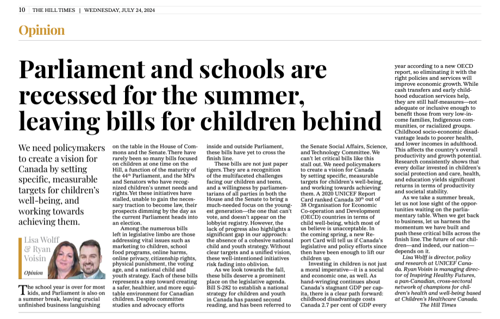
Since Bill S-212 was tabled in the Senate in early May 2025, Children’s Healthcare Canada has been supporting and advocating for this bill to be passed.
Specifically, the Senate Standing Committee on Social Affairs (SOCI) invited testimony from CHC on the topic of Bill S-212; CHC CEO Emily Gruenwoldt testified in support of the bill. She outlined the urgent need for coordinated national action to improve the health and well-being of children and youth across the country. She expressed strong support for a legislated, outcome-driven strategy that aligns federal, provincial, and territorial investments around measurable results—ensuring accountability, equity, and sustained progress beyond election cycles.
On March 13th, MP Braedon Clark tabled the Bill in the House Commons after it was adopted by the Senate. It will now progress through the House of Commons and we continue to champion this work until the bill receives Royal Assent.
Watch her testimony here.
 |
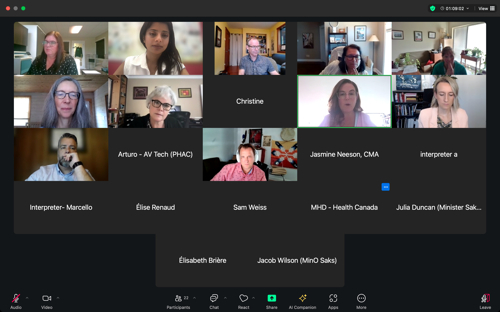
In December 2025, the House of Commons Standing Committee on Health invited Children’s Healthcare Canada (CHC) and Pediatric Chairs of Canada (PCC) to provide testimony on recruitment barriers facing international trainees and licensed healthcare providers. Dr. Meredith Irwin (Pediatric Chair, University of Toronto) appeared on behalf of both organizations.
Watch her testimony here.
 |
6. Positioning Children’s Healthcare Infrastructure as a priority for the eligibility of the Building Canada Strong Fund
More recently, we obtained confirmation that the $5 billion dedicated to health infrastructure is being delivered through bilateral agreements with provinces and territories. Under these agreements, provinces and territories are responsible for identifying and submitting the projects they wish to undertake. These submissions are then approved by the Minister of Housing and Infrastructure, in accordance with the program’s terms and conditions. Regarding engagement, proponents should begin by working with their respective provincial or territorial health departments, as they are responsible for selecting projects. With respect to timelines, these will depend on each province or territory’s internal process for identifying and putting forward projects under the program Build Communities Strong Fund.
This is a file we will keep following closely and we will share relevant updates as they become available.
In partnership with the Safer Online Spaces Coalition, Children’s Healthcare Canada co-signed a letter to Minister Mark Miller calling for stronger action and accountability to better protect children and youth online, noting that Canada now ranks near the bottom of high-income countries on youth well-being and that harmful online experiences—including compulsive use, reduced self-worth, cybervictimization, and self-harm behaviours—are contributing to worsening mental health outcomes and rising hospital admissions. The coalition is urging the federal government to introduce a credible, made-in-Canada Online Safety Act grounded in public oversight, accountability, and enhanced protections for children and youth, including a clear duty for platforms to assess and mitigate foreseeable harms and an independent regulator with real enforcement powers.
 |
8. Interim Federal Health Program
In early 2026, CHC wrote to Minister Lena Diab to express concern about proposed changes to the Interim Federal Health Program and the potential consequences for refugee children and families. We shared that CHC members—including children’s hospitals, community hospitals, rehabilitation centres, and mental health agencies—are concerned about how the introduction of copayments could affect access to essential care for refugee children and youth.
To participate in this advocacy campaign, reach out to your elected official through the Canadian Pediatric Society’s online writing tool.
9. List of Therapeutic Products Pre-approved for Special Access
New legislation to improve access to essential medications not available in Canada was introduced in Parliament on March 11, 2026. Bill C-265 is An Act to amend the Food and Drugs Act (List of Therapeutic Products Pre-approved for Special Access) and it was introduced by former emergency room physician, now Member of Parliament for Thunder Bay – Rainy River, Dr. Marcus Powlowski. We want to thank our partner organizations RareKids-CAN network and the Child Health Policy Accelerator at The Hospital for Sick Children, who collaborated closely with MP Polowski on this Private Members Bill. Together, they worked to advance practical policy solutions to improve timely access to life-saving treatments.
Working Together to Keep Children’s Health on the National Agenda
Canada’s children’s healthcare systems are stretched to the limit, and we need governments to invest strategically. Here’s how you can help ensure children’s health remains a national priority.
Share and Spread the Word.
Be a voice for kids by using your social media channels to share our messages, policy priorities, and informative webinars. Join the conversation- the more visible we are, the greater our impact!
Engage with your Local Members of Parliament.
Who is your organization’s local MP? Please learn more about them and reach out to them to encourage them to prioritize children's health.
Find out here: Who Represents Your Organization in Parliament?
Share Resources.
Share our tools (reports, podcasts, newsletters, webinars) with your professional and community networks.
Participate in Government Consultations.
Participate in government consultations, such as those conducted by the Standing Committee on Health (HESA), to influence policy decisions that improve children's health. You can join either as an organization or through Children’s Healthcare Canada.